
Reviewed · TORINO MAGICA: MAGIC, MYSTERY & UNDERGROUND
Ghosts of Turin: Hidden Spell Exploration Game
A spooky city stroll with clues on your phone. That’s what makes Ghosts of Turin different: it turns landmarks into a self-guided challenge trail instead of a sit-and-listen tour. You’ll get directions between stops, plus spooky stories and mysteries tied to some of central Turin’s most interesting corners.
I like how flexible it is. You can start whenever you want, take a break, then resume later without losing the thread. I also like that it’s low-contact and designed for just you and your group—no physical guide, no crowds to herd you along.
One watch-out: it depends on the app working smoothly on your device. If activation fails, you’ll need to troubleshoot with support (you can email [email protected]), so make sure your phone is charged before you set off.
In This Review
- Key things to know before you play
- How the Ghosts of Turin phone game works (and why that’s a win)
- Piazza Statuto and the Black Heart legend—your first clue zone
- La Consolata (Santuario della Consolata): a sanctuary you can find instantly
- Rondò della Forca: esoteric Turin at a street confluence
- Palatine Gate: Roman leftovers you can actually touch
- Madama Palace: widows of Savoy and a museum stop
- Piazza Castello, arcades, and the Via Po clue corridor
- Piazza San Carlo: Baroque geometry and named-for-someone symbolism
- Palazzo Trucchi di Levaldigi and the big wooden door detail
- A church stop with 1600s to 1700s artworks (single-nave design)
- Ending at Ponte Vittorio Emanuele I: the Po river gateway finish
- Price and value: $8.11 for 90 minutes of self-guided mystery
- Practical tips so the app keeps working
- Who should book Ghosts of Turin (and who might not love it)
- Should you book this escape game in Turin?
- FAQ
- Where does the game start and end?
- How long does Ghosts of Turin take?
- How much does it cost?
- Can I start at any time of day?
- Do I need a physical tour guide?
- Do I need internet while exploring?
- Is there a mobile ticket?
- Is this experience private for my group?
- Are service animals allowed?
- What if something goes wrong with the app activation?
- What’s the cancellation window?
Key things to know before you play
- Self-paced outdoor route: follow clues at your own speed, not a fixed walking group tempo
- No getting lost: step-by-step directions in the app move you between locations
- Smartphone, offline-friendly: you don’t need an internet connection while exploring
- Flexible start time: available 24/7 and you can begin at any hour
- You choose the pace: pause whenever you like and restart later
- Final walk ends at Ponte Vittorio Emanuele I: an easy-to-find finish line
How the Ghosts of Turin phone game works (and why that’s a win)
This is an outdoor escape-game-style experience that you play on your smartphone. Instead of following a guide, you follow on-screen instructions and complete challenges at each stop to move to the next location.
Two practical advantages matter here. First, the route includes directions so you don’t waste time searching streets or guessing where the next clue lives. Second, you can keep your own rhythm—slow down for photos, linger if a detail grabs you, or speed up when the trail feels easy.
The experience is also built to be offline while you explore. That’s helpful in older-city streets where signal can be spotty, and it means you’re not constantly burning data just to follow the story.
Piazza Statuto and the Black Heart legend—your first clue zone
The game begins at Piazza Statuto. This square has layers: it was once home to a Roman necropolis, it later became tied to a French execution site, and it was the scene of a terrible fire in 1983.
In the center, the fountain is tied to the tragedy of the workers who died digging the Frejus Rail Tunnel. In the game’s story framing, that fatal legacy gives the area the name Black Heart, and your first task pushes you to look around rather than read a panel and move on.
Practical tip: stand still for a minute before you start hunting. You’ll get the best results when you can compare what you see in front of you with what the clue is trying to point out.
More magic, mystery and underground walks beneath Turin




La Consolata (Santuario della Consolata): a sanctuary you can find instantly
Next up is the Santuario della Consolata, also known as La Consolata. The church is a prominent Marian sanctuary and a minor basilica, located at the intersection of Via Consolata and Via Carlo Ignazio Giulio.
This stop works well for the game format because it’s a clear landmark you can orient around. Your challenge again asks you to look around to find the answer, and the story connects the place to its role in Turin.
If you’re playing without internet, it helps to set your phone up before you arrive (brightness up, volume on, battery safe). The game wants you to move step-by-step, and a low-battery scramble can ruin the mood.
Rondò della Forca: esoteric Turin at a street confluence
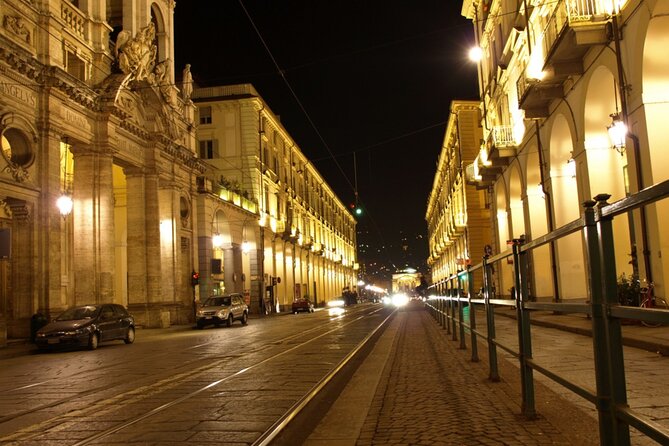
The Rondò della Forca is presented as a point that draws esoteric tourism. The name points to a specific location in the area formed by the confluence of several courses, with via Cigna also nearby—close to Piazza dello Statuto, one of the hubs of this side of Turin.
For puzzle lovers, this kind of stop is satisfying. You’re not just walking past a famous building; you’re scanning the street pattern and the surroundings to line up with the game’s question.
A note for real-life walking: intersections can be busy even when the buildings are quiet. Keep your phone out of your pocket only when you need it, and cross streets carefully while you hunt for answers.
More Turin walks along the porticoes and past the Mole
- Turin: Small-Group Walking Tour of Top City Highlights
★ 4.8 · 839 reviews - Turin: City Highlights Guided E-Bike Tour
★ 4.9 · 218 reviews - UNUSUAL and hidden Turin for curious people
★ 5.0 · 212 reviews - Highlights and hidden gems of Turin Bike Tour
★ 5.0 · 152 reviews
Palatine Gate: Roman leftovers you can actually touch
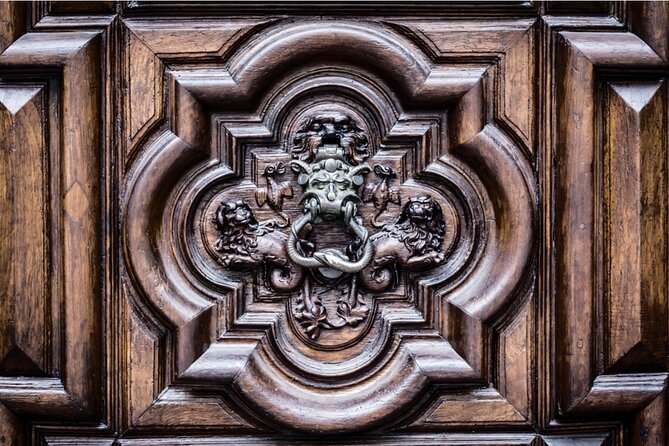
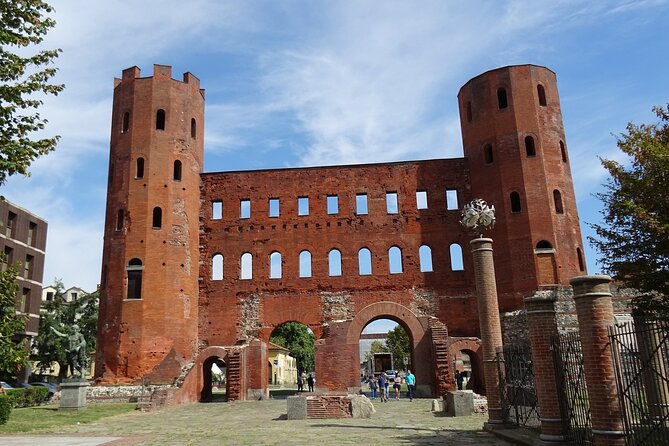
One of the strongest “wow” stops on the route is the Palatine Gate. It’s described as the main archaeological evidence of Turin’s Roman phase and one of the best-preserved 1st-century BC Roman gateways in the world.
The gate sits within the Archaeological Park area, opened in 2006. In the game, you’re again asked to look around to find the answer and advance, which is a nice way to make the stone feel less like a random artifact and more like part of your personal route.
Even if Roman history isn’t your thing, this stop is still worth it because it’s visually clear. The gateway shape gives you something concrete to orient around, and the clue-style scavenging keeps you active instead of stuck reading.
Madama Palace: widows of Savoy and a museum stop

Next is Madama Palace. It began in the 13th century, and the name is tied to resident widows of the 17th-century dukes of Savoy.
Historically, it has served the Sardinian Senate (1848–60) and the Italian Senate (1861–64). Today, it houses the Museum of Ancient Arts, and the game uses the palace as another storytelling checkpoint where you hunt for answers before moving on.
What I like about this kind of stop is the mental shift. You go from “what’s the clue?” to “oh, that’s why this building matters,” and the game framework nudges you to pay attention in a way a standard tour can miss.
Piazza Castello, arcades, and the Via Po clue corridor
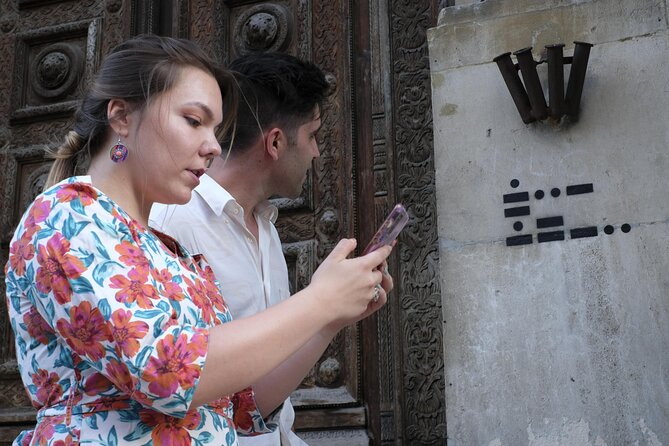
The route then moves through Piazza Castello, a central city square lined with museums, theaters, and cafes. This is useful in game terms because squares give you open sightlines—good for regrouping, checking your phone, and making sense of where you are.
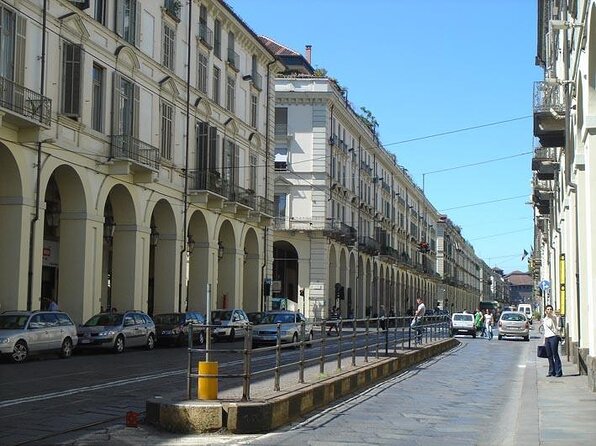
From there, you’ll reach the arcaded Via Po, built by Amedeo di Castellamonte in 1868. The arcade walkway is highlighted as featuring important buildings, including the first original building of the University of Turin and Caffè Fiorio.
This is one of the best areas to play slowly. You can pause under the arcades, enjoy the rhythm of the walkway, and still feel like you’re progressing because the game is constantly giving you the next target.
Piazza San Carlo: Baroque geometry and named-for-someone symbolism
Piazza San Carlo is one of Turin’s main squares, laid out in the 16th and 17th century and described as an example of Baroque style. The square’s current name is an homage to Charles Borromeo, though it has been known by other names like Piazza Reale and Place Napoleon.
In the game format, this stop likely serves as another “look around” moment where the square itself becomes the puzzle space. The advantage here is that the architecture and layout give you stable landmarks—less guesswork, more “I can see what they’re pointing me toward.”
If you’re playing during the busiest part of the day, plan for crowds around the cafes. The game is designed to avoid you being herded by a tour group, but squares are squares, so pace yourself.
Palazzo Trucchi di Levaldigi and the big wooden door detail
At Palazzo Trucchi di Levaldigi, you’ll focus on a specific standout feature: a massive wooden door commissioned in the 17th century by the Earl of Trucchi di Levaldigi.
This stop is fun because it’s tactile in the mind. Even without heavy explanation, a huge door is the kind of landmark your brain remembers. It’s also a smart choice for an outdoor game, because it’s easier to spot an obvious detail while you’re hunting for answers.
My advice: when you reach this stop, take a step back first. Then look again up close. Your clue may relate to size, placement, or design—those details can be hard to catch if you only do one quick pass.
A church stop with 1600s to 1700s artworks (single-nave design)
One of the later stops is a church built between 1648 and 1656, designed by Carlo Morello. It’s described as a single-nave church without external arcades, then with changes later: from 1683, the choir was enlarged and two side chapels were added.
In the 18th century, important works were added to the interior, including a main altar by Bernardo Vittone and other specific elements credited to Francesco Martinez and a wood support procession created by Beaumont da Giuseppe and Stefano Maria Clemente.
This is a good example of why the game format works. You’re not just admiring the outside. The puzzle-based “look around” style can push you to notice architectural changes over time, which is more interesting than a quick pass-through.
If the church interior access is limited at your time of play (not stated either way), you’ll still get value from the exterior features described. But if you can see inside, plan a few extra minutes so the art notes don’t turn into a blur.
Ending at Ponte Vittorio Emanuele I: the Po river gateway finish
The experience ends at Ponte Vittorio Emanuele I, the oldest existing bridge in Turin. It’s also described as the most beautiful and important, and crossings here were always crucial for the city.
Between the 15th and 19th centuries, this bridge acted as one of the main gateways into Turin. Finishing here makes sense: after solving clues across Roman, Baroque, and palace settings, you get a strong sense of “this city is connected by its streets and crossings.”
Practical win: the finish point is easy to locate, so you can plan your next step—coffee, a museum visit, or just heading back on public transportation.
Price and value: $8.11 for 90 minutes of self-guided mystery
At $8.11 per person, this is priced like an entry-level activity, not a premium guided tour. For that money, you’re getting a 1 hour 30 minutes game framework (approx.), smartphone-based navigation, and a route that strings together multiple major Turin sights.
The best value part isn’t just cost. It’s that you control the pace. If you love wandering but hate rigid tour schedules, this format turns a normal walking day into something structured—without the cost of a professional guide.
There’s also a “logistics savings” factor. With step-by-step directions and a set end point, you spend less time figuring out where to go next. That’s time you can spend on actually looking.
If you’re traveling as a group, the listing mentions group discounts, which can make the cost drop further. If you’re traveling solo, you still have a strong baseline: a low-cost way to see key areas in central Turin.
Practical tips so the app keeps working
This experience is built to work without internet, but your phone still needs to be ready.
- Charge your battery before you start, especially if you’ll take photos while playing
- Use offline-friendly mode as instructed; don’t rely on spotty data in central Turin
- Follow step-by-step instructions closely so you don’t miss the next clue
- If activation has trouble, email [email protected] for help
And one more tip that saves stress: when the game says look around, do it deliberately. Move from broad view to close view. That’s how you catch the detail the clue is probably aiming at.
Who should book Ghosts of Turin (and who might not love it)
You’ll likely enjoy this if you want a short, self-paced walking experience with puzzle moments and spooky storytelling flavor. It’s also a nice fit if you prefer to explore independently but still want the comfort of directions between stops.
If you want a traditional tour with a human guide explaining context in real time, this one might feel too hands-on. You’re doing the interpretation yourself, with clues instead of commentary.
Also consider this format if you’re sensitive to tech. The experience is phone-led, so it’s best when your device is reliable and you’re comfortable following on-screen prompts.
Should you book this escape game in Turin?
I’d book Ghosts of Turin if you’re the type who likes turning sightseeing into a game and keeping control of your schedule. At $8.11, for 90 minutes, it’s a strong value move—especially if you want to avoid the chore of coordinating with a guide and you’re happy to navigate using your phone.
I wouldn’t book it if you’re hoping for a classic guided lecture or if you know your phone reliably struggles with app activation. If that’s you, test your setup in advance and have the support email ready ([email protected]).
FAQ
Where does the game start and end?
It starts at Piazza Statuto, Torino and ends at Ponte Vittorio Emanuele I, 10124 Torino.
How long does Ghosts of Turin take?
The experience runs about 1 hour 30 minutes (approx.).
How much does it cost?
It’s listed at $8.11 per person.
Can I start at any time of day?
Yes. The experience is available 24/7, and you can start whenever you like.
Do I need a physical tour guide?
No. You play without a physical guide and there is no human contact.
Do I need internet while exploring?
No. You can play offline, and you do not need an internet connection while exploring.
Is there a mobile ticket?
Yes. It uses a mobile ticket.
Is this experience private for my group?
Yes. It’s described as private, with only your group participating.
Are service animals allowed?
Yes, service animals are allowed.
What if something goes wrong with the app activation?
Confirmation is provided at booking, and if activation fails you can contact support at [email protected].
What’s the cancellation window?
You can cancel for a full refund up to 24 hours in advance. If you cancel less than 24 hours before the start time, the amount paid is not refunded.
More Tour Reviews in Turin
- Turin: Torino+Piemonte 2-Day City Card★ 4.6 · 1,837 reviews
- Turin: Guided Egyptian Museum Tour★ 4.7 · 1,573 reviews
- Turin: Magic Guided Tour★ 4.6 · 1,447 reviews
- Turin: Turin & Piedmont 3-Day City Card★ 4.7 · 1,434 reviews
- Turin: Egyptian Museum Small Group Skip-the-Line Guided Tour★ 4.8 · 1,332 reviews
- Turin: Hop-on Hop-off Bus Tour with 24 or 48-Hour Ticket★ 4.2 · 941 reviews
More Turin Walks along the Porticoes
- Turin: Small-Group Walking Tour of Top City Highlights★ 4.8 · 839 reviews
- Turin: City Highlights Guided E-Bike Tour★ 4.9 · 218 reviews
- UNUSUAL and hidden Turin for curious people★ 5.0 · 212 reviews
- Turin Noir: The Darkest Walking Tour★ 4.7 · 196 reviews
- Highlights and hidden gems of Turin Bike Tour★ 5.0 · 152 reviews
- Turin: Highlights and Hidden Gems Guided Bike Tour★ 4.9 · 126 reviews
More Torino Magica and Underground Walks
- Turin: Magic Guided Tour★ 4.6 · 1,447 reviews
- Turin: Underground Tunnels Guided Tour★ 4.6 · 541 reviews
- Torino Magica® Evening Tour★ 4.5 · 204 reviews
- Turin Noir: The Darkest Walking Tour★ 4.7 · 196 reviews
- Turin: Torino Sotterranea® guided tour★ 5.0 · 65 reviews
- Turin: Egyptian Museum Monolingual Skip-the-Line Guided Mystery Tour,Small group★ 5.0 · 55 reviews
Not sure yet? Here are more Turin tours and Piedmont escapes we have written up





Torino Magica: Magic, Mystery & Underground, compared.
 ★ 4.6Magic Guided TourFrom $621,447 reviews
 ★ 4.6Underground Tunnels Guided TourFrom $62541 reviews
 ★ 4.5Torino Magica® Evening TourFrom $42204 reviews
 ★ 4.7Turin Noir: The Darkest Walking TourFrom $37196 reviews
 ★ 5.0Torino Sotterranea® guided tourFrom $4765 reviews
 ★ 5.0Egyptian Museum Monolingual Skip-the-Line Guided Mystery Tour,Small groupFrom $6655 reviews
 ★ 5.0Turin between magic, tarot cards and legendsFrom $4231 reviews
 ★ 5.0Alchemy, Whispers, Magic and Mysteries Private TourFrom $10011 reviews
Browse the lists this tour appears in